
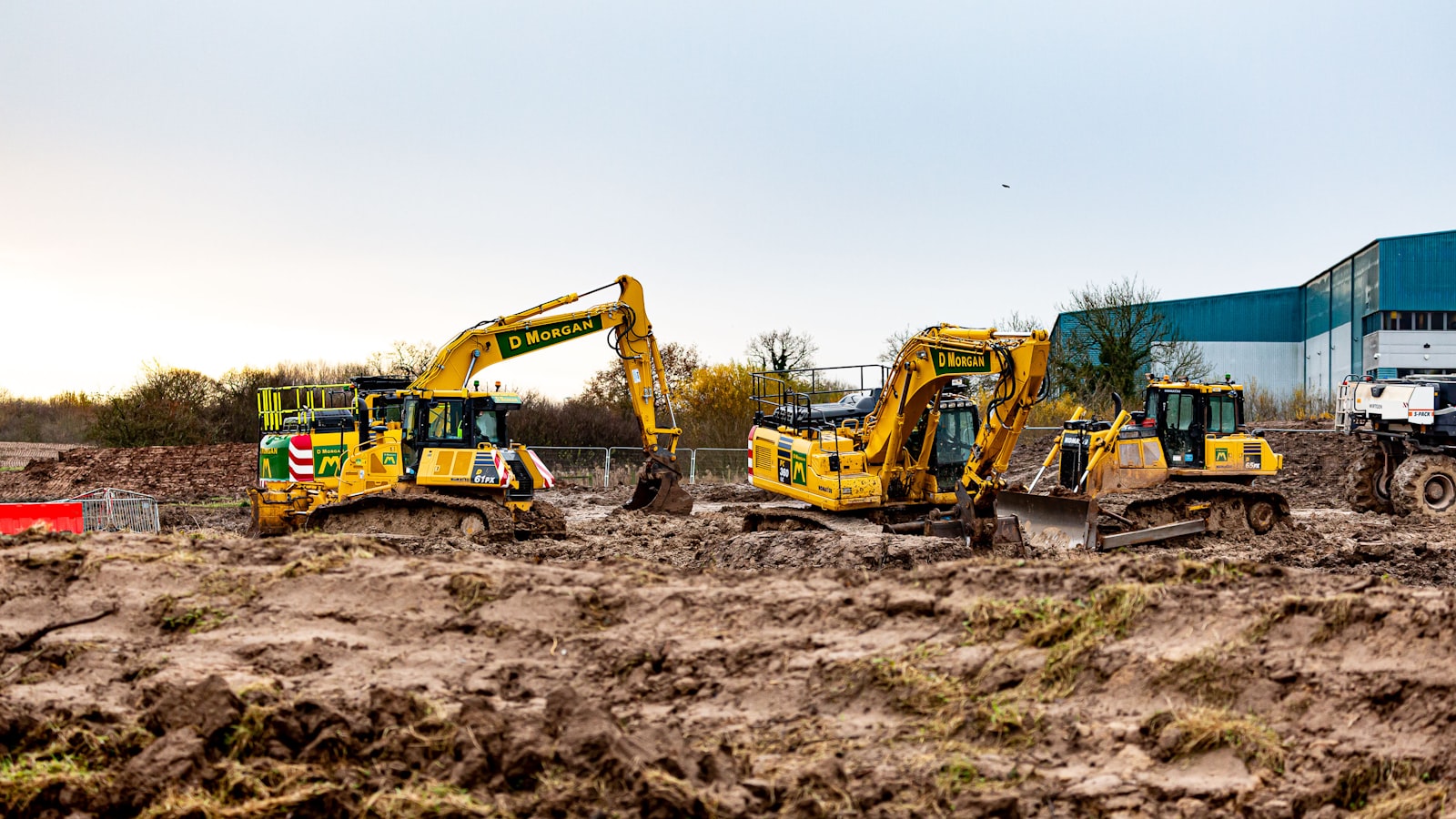
Standing Water on Tennessee Clay: How Grading and Drainage Correction Save Your Foundation, Barn, and Yard
You have seen it on your own place. Three days after a good rain, there is still a soft spot in the yard. The low corner by the barn holds water. The area around the foundation stays dark and damp when everything else has dried out.
On Middle Tennessee clay, that is not bad luck. That is drainage doing exactly what the grade told it to do.
Here is why it happens, what it costs you if you leave it, and what actually fixes it.
Why clay makes this worse
Most of the soil around Columbia, Spring Hill, Franklin and Lewisburg has a heavy clay component. Clay does two things that sandy soil does not.
First, it drains slowly. Water that would percolate straight down through sand sits on top of clay and waits. Second, clay moves. It swells when it takes on water and shrinks when it dries out — and it does that cycle every wet season and every dry summer.
That movement is the part landowners underestimate. Soil that expands and contracts against a foundation, a barn slab, or a driveway base is applying pressure, then removing it, over and over. Nothing built on it enjoys that.
What standing water actually costs
Your foundation
Water pooling against a foundation is the expensive one. Saturated clay pressing against a wall, then shrinking away from it, then pressing again — that is how cracks start and how water finds a way into a crawl space or basement. Repairing a foundation costs many multiples of what it costs to move the water away from it in the first place.
Your barn, shop or garage
A pad that sits in a low spot stays wet underneath. Equipment stored on it takes on humidity, the slab edge stays saturated, and any post or column in contact with the ground has a much shorter life. If the pad was placed without the grade being corrected first, the problem was built in on day one.
Your driveway
Gravel over saturated clay does not stay put. The base pumps and softens, ruts form, and you are hauling in more rock every spring to chase a problem that is underneath the rock, not in it.
Your yard and your septic field
Standing water kills grass, breeds mosquitoes, and makes half your property unusable for weeks at a stretch. And if the water is collecting anywhere near a drain field, that is a conversation worth having with your septic professional before it becomes a bigger one.
What actually fixes it
There is a common instinct to solve standing water with a drain — dig a trench, drop in pipe, done. Sometimes that is right. Often the drain is treating a symptom of a grade that was never established correctly.
The order of operations matters.
1. Find out where the water is actually coming from
Before anything gets dug, somebody needs to walk the property and understand where water enters, where it travels, and where it stalls. Roof runoff with no gutters or downspout extensions. A neighboring property draining onto yours. A driveway acting as a dam. A pad built up without a path for water around it. The fix depends entirely on the cause.
2. Correct the grade
This is the fundamental fix and the one that solves the most problems. Ground should fall away from structures — the foundation, the barn, the shop. Where the yard has settled or was never shaped properly, finish grading re-establishes that fall and gives water a direction to go instead of a place to sit.
Grading is also the cheapest fix per problem solved, because it addresses the cause rather than intercepting the result.
3. Give the water somewhere to go
Grading only works if there is an outlet. That is where swales come in — shallow, gentle, grassed channels that move water across a property without looking like a ditch. On acreage, a well-shaped swale can move a lot of water quietly, and you can still mow over it.
Dry beds serve the same purpose where the flow is more concentrated or the slope is steeper, and they hold up better under volume.
4. Handle the concentrated sources
Roof water is concentrated water. Downspouts dumping at the corner of a foundation put hundreds of gallons in one spot during a single storm. Getting that water piped out and away from the structure is often the highest-return thing you can do on the whole property.
The same goes for culverts. If your driveway crosses a natural drainage path and there is no culvert — or the one that is there is undersized or crushed — the driveway is acting as a dam and backing water up onto the ground behind it.
Why the timing matters here
Middle Tennessee gives you a real window and a real penalty for missing it.
Grading work in saturated clay is difficult. Equipment tracks it up, the material does not shape well, and you cannot compact wet clay properly. Work done in the middle of a wet stretch often has to be touched up later.
Drier ground shapes cleanly, compacts properly, and holds. If you have a drainage problem you have been living with, the sensible move is to get it looked at before the wet season rather than during it — and to plan for the fact that most projects here schedule two to four weeks out from a signed quote.
What to expect from a quote
Drainage correction is not a per-foot commodity. What drives the number is straightforward, and any contractor should be able to explain it standing in your yard:
- How much area needs to be reshaped, and how much material has to move
- Whether there is a usable outlet, or one has to be created
- Access — whether equipment can get to the work without tearing up everything between here and there
- Whether culvert or pipe work is involved
- What has to be restored afterward
Anyone who gives you a firm number over the phone without seeing the property is guessing. Terrain, access and where the water actually goes are things you have to stand on to know.
Get someone out to look at it
We run grading, drainage correction, and site prep across Maury, Williamson and Marshall counties — Columbia, Spring Hill, Mount Pleasant, Franklin, Thompson's Station, Nolensville, Arrington, Lewisburg and Chapel Hill. Licensed Tennessee General Contractor, fully insured, certificates of insurance available on request.
Boots on the ground. Equipment in the dirt. You will talk to the person running the job, not a call center — and you will get a real number instead of a guess.
Request a free on-site quote at https://auroraexcavators.com/quote — most quotes go out within 24 to 48 hours. Or call or text (615) 669-1442 if you would rather just talk it through. See our service areas at https://auroraexcavators.com/service-areas.
Built right and built to drain.