
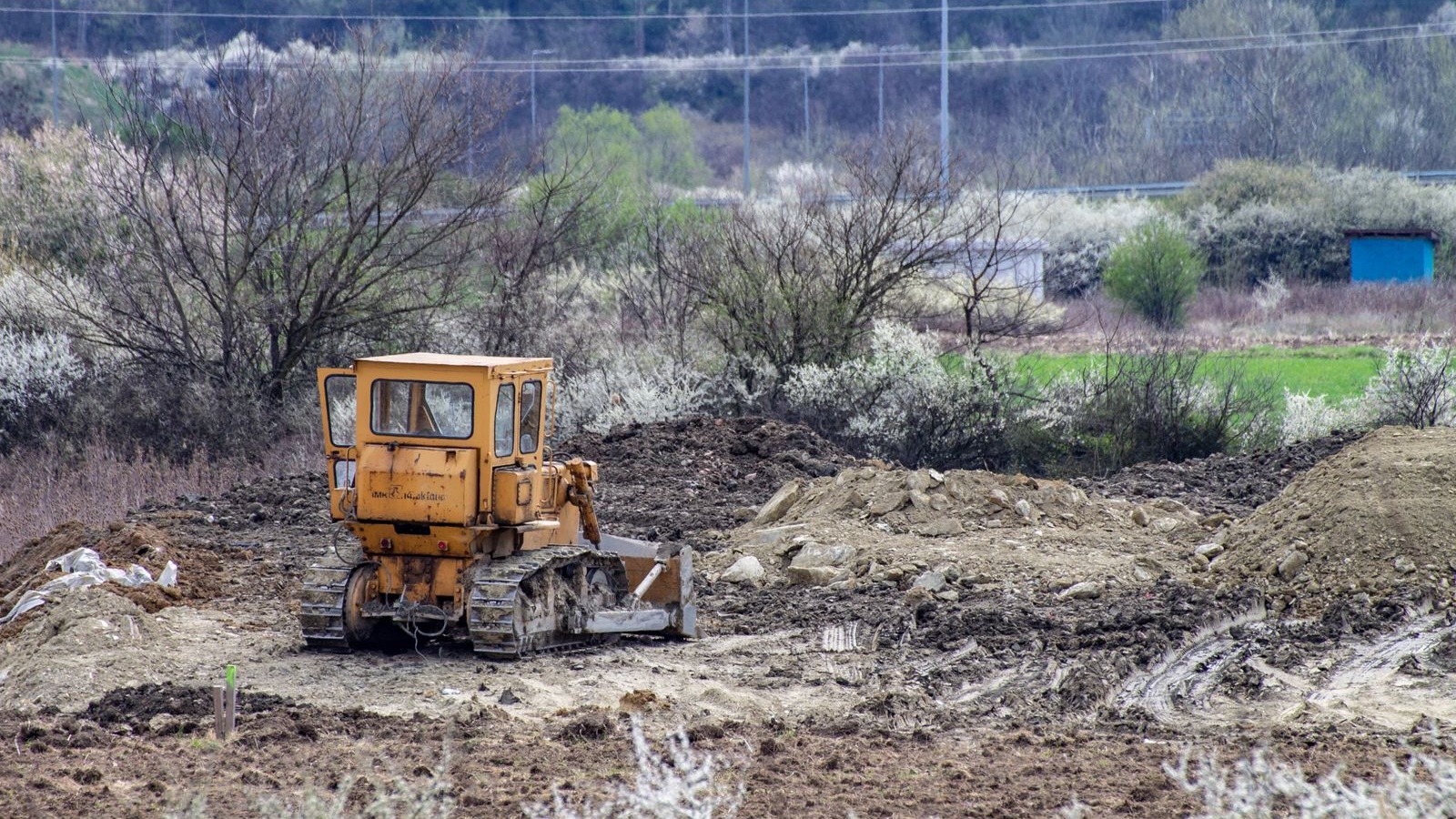
Lot Leveling on a Sloped Middle Tennessee Yard: Turning Ruts and Grade Into Ground You Can Actually Use
You've got two acres behind the house that you can't really use. Part of it slopes hard enough that the mower feels sketchy sideways. There are ruts from where the previous owner drove a truck through in the spring. Water sits in the low corner for three days after every good rain, and the spot where you wanted to put the shop is about four feet lower on one end than the other.
That's lot leveling. And it's one of the most common calls we get in Maury, Williamson and Marshall counties, because it's the kind of problem that looks like it should be simple and isn't quite.
Here's how it actually works, so you know what you're buying.
First: leveling almost never means flat
This is the biggest misunderstanding, and it matters because it changes the whole scope.
A truly flat yard is usually a bad yard. Water has to go somewhere. If you take a sloped lot and make it dead level, you've built a bathtub — and in Middle Tennessee clay, which drains slowly on its best day, that water is going to sit against whatever you build.
What you actually want is controlled grade: usable, walkable, mowable ground that still moves water deliberately away from structures and toward somewhere it can go. Usually that means a gentle fall away from the house or barn for the first several feet, then whatever slope the rest of the yard needs to carry water off the property without dumping it on your neighbor.
When we say we're leveling a yard, we mean making it consistent and usable with intentional drainage — not making it a tabletop.
What actually happens on a lot leveling job
Walk it and find the water first. Before anything moves, we want to know where water enters the property, where it currently pools, and where it can legally and practically leave. Grade follows drainage. Getting this backwards is how yards get regraded twice.
Strip and stockpile the topsoil. The good soil is the top few inches, and it took a long time to become good soil. We push it off to the side, do the earthwork in the subsoil beneath, and put the topsoil back on at the end. Skipping this step is why some regraded yards won't grow grass afterward — the finished surface is raw clay.
Cut and fill. The efficient move is balancing the site: take material off the high spots and use it to build up the low ones, so you're not paying to haul dirt in or out. That only works if the volumes roughly match. If your low corner needs more fill than your high spot can give, we're bringing material in, and that's a real line item you should hear about in the quote rather than discover later.
Compact the fill. This one is invisible and it's the one that separates a job that holds from a job that settles. Fill placed in thin lifts and compacted stays put. Fill dumped in and pushed around looks identical on day one and develops soft spots and depressions over the first year or two. If you're going to put a shop, a driveway or anything with a foundation on it, compaction is non-negotiable.
Fix the ruts properly. Truck ruts in clay aren't just surface damage — the soil underneath has been compacted and displaced. Filling them with dirt and smoothing over produces ruts again in the same spot. They need to be opened up, the material replaced and compacted, then finished.
Finish grade and topsoil back. Final pass to set the surface, topsoil spread back over it, and the site left ready to seed. We'd rather leave a property clean and ready to grow than leave you a moonscape and a bill.
What drives the price on a sloped lot
People want a number per acre, and we understand why. The honest answer is that slope work varies more than most excavation because a few specific things swing it:
- How much material has to move. A yard needing a foot of correction across a half acre is a very different job than one needing four feet in one corner. Volume drives hours.
- Whether the site balances. If cut and fill match, you avoid haul costs entirely. If not, trucking dirt in or out is often the largest single item.
- Rock. This is Middle Tennessee. Limestone shelf sits closer to the surface in some spots than others, and hitting ledge where you needed to cut changes the equipment and the timeline. We'd rather flag the possibility during the walkthrough than surprise you with it.
- Access. Gates, tree lines, overhead power, soft ground, and how close we can get equipment to the work all affect how many hours the job takes.
- What goes on top. Ground that's getting grass has a different compaction standard than a pad for a shop. Tell us what you're planning even if it's two years out — building to the higher standard now is far cheaper than redoing it later.
The drainage decisions that come along with it
Most lot leveling jobs turn into a drainage conversation, because that's usually the actual problem underneath the complaint.
Depending on the site, the fix might be a swale — a shallow, graded channel that carries water across the property to somewhere it can go — or a dry bed, or simply establishing enough fall that water never gets a chance to stand. These are usually far less expensive than people expect, and they're much cheaper installed while the equipment is already on site than as a separate trip next spring.
If water is running toward a foundation or a barn, that's the priority regardless of what the rest of the yard looks like.
Before you call anybody
Four things that make the quote faster and more accurate:
- Take photos after a hard rain, while the water is still standing. That single image tells us more than a dry walkthrough does.
- Know roughly where your property lines are.
- Know what you eventually want the space for — yard, pad, drive, pasture, all of it.
- Note any known septic, well lines or buried utilities.
How we work
We're a licensed Tennessee general contractor, fully insured, ten-plus years working this ground. Certificates of insurance are available on request — ask us, and ask anyone else you're getting a quote from.
Most quotes go out within 24–48 hours of the walkthrough, and most projects get scheduled within 2–4 weeks of a signed quote. You'll talk to the person who's going to be running the job, not a call center.
Got a sloped yard, a rutted lot, or a low corner that stays wet? Call us at (615) 669-1442 for a free on-site quote, and we'll walk it with you.