
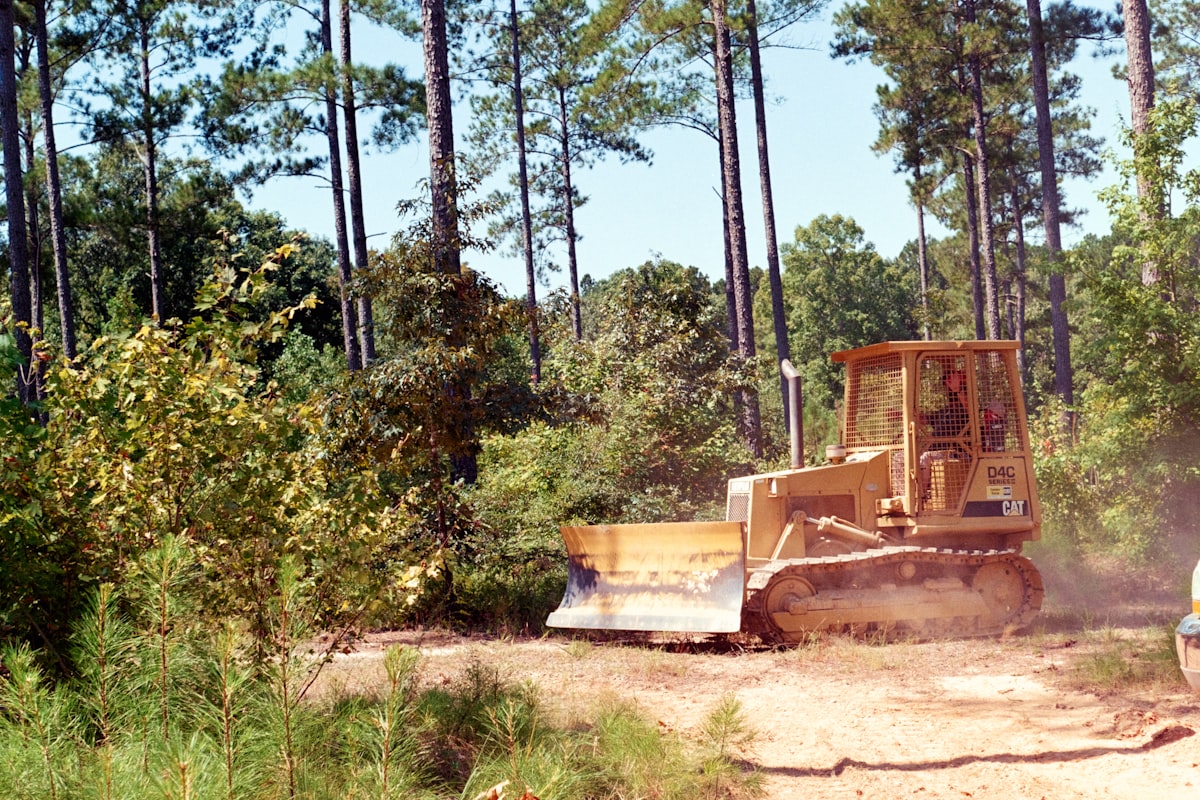
What Land Clearing Really Costs Per Acre in Middle Tennessee: The 5 Factors That Move Your Quote Up or Down
It's the first question almost every landowner asks, and it's a fair one: what does it cost to clear an acre?
Here's the honest answer. Anybody who gives you a firm per-acre number over the phone, before they've walked your property, is guessing. Two acres a mile apart in Maury County can price thousands of dollars apart, and neither quote is wrong. The land is just different.
That doesn't mean you have to fly blind. The price isn't a mystery — it moves on five specific things, and you can look at your own land right now and get a good feel for where you'll land. Here's what actually drives the number.
Why a per-acre price over the phone is a guess
Across Middle Tennessee, land clearing generally runs somewhere from a couple thousand dollars an acre for light brush and scrub up past ten thousand an acre for heavy mature timber that has to come down, get stumped, and get hauled off. That's a wide range on purpose. It's a starting frame, not a quote.
The spread exists because "clearing an acre" describes about six different jobs. Knocking down five years of privet and cedar sprouts on an old pasture is a day with a mulcher. Taking an acre of mature hardwood down to bare, buildable dirt with every stump pulled and every stick trucked off the property is a different operation with different equipment and different days on site.
So the useful question isn't "what's your acre price." It's "which of these five things is going on with my land."
The 5 factors that move your quote up or down
1. What's actually growing on it
Density and trunk size drive more of your bill than raw acreage does. Brush, briars, saplings, and volunteer cedar are fast work. A mulcher eats that. Mature oak and hickory at two feet across is slow, careful work — it comes down in sections, it has to be handled, and it takes a bigger machine and more hours per acre.
Look at your acreage and count the trees you'd call big. Ten of them across an acre is a different job than a hundred. This single factor is often the whole difference between two quotes.
2. What happens to the debris
Every tree you drop has to go somewhere, and you've got four choices. Mulch it in place. Burn it, where the county and conditions allow. Pile it in a spot you don't care about. Or haul it off.
They cost very different amounts. Forestry mulching leaves the material on the ground as a mulch layer that holds soil and breaks down — no trucks, no dump fees, usually the cheapest path. Haul-off is the most expensive, because you're paying for loading, trucking, and disposal on top of the clearing itself. Piling is cheap up front, but you still own the pile.
It's your call, and it's the one lever most landowners don't realize they're holding. If you're clearing a pasture and don't need bare ground, mulching can cut a quote substantially.
3. Terrain, slope, and Tennessee clay
Flat, dry, and open is fast. Steep, rocky, wet, or cut up with draws is slow. On a slope, machines work in shorter passes and everything takes longer. Add rock and you're into equipment that costs more per hour to run.
Then there's our clay. Middle Tennessee ground holds water, and after a wet stretch a site that would be a three-day job in September turns into ruts and stuck equipment in March. Wet ground doesn't just slow the work — sometimes it means waiting, which is why the same acre quoted in different seasons can come back at different numbers.
4. Access
Equipment has to get there. If we can pull a lowboy right up to the work area, that's the best case. If the only way in is a narrow farm gate, a soft field, a low bridge, or a quarter mile of overgrown two-track, we may have to clear a path just to start, use smaller machines than the job wants, or make more trips.
Overhead power lines, neighboring fence lines, septic fields, and where the trucks can turn around all factor in too. Access is invisible on a map and obvious the second you stand on the property. It's a big reason we quote on site.
5. How "clear" you actually need it
There's a real cost difference between cleared and build-ready, and knowing which one you need protects your budget.
Mulching down to a clean, walkable surface with root systems intact is one price. Grinding stumps is a step up. Full extraction — pulling stumps and root balls out, then backfilling and grading the holes — is more again, but it's what you need if a foundation, a barn pad, or a shop is going on that ground. Nobody wants to pay to clear an acre twice because the first pass left stumps under a future slab.
Tell your contractor what's going on that land after the trees are gone. That answer sets the scope.
How to read two quotes that are thousands apart
When you get a low number and a high number on the same acreage, the gap is almost never one contractor being greedy. It's scope.
Read both quotes for the same four things. Does it include stumps, and are they ground or pulled? Where does the debris end up — mulched, piled, or gone? Does it include any grading, or is it clearing only? And is the price per acre or for the whole job, because on a partial acre those are very different bills.
Once you line those up, the quotes usually explain themselves. If one is still dramatically cheaper, ask whether the contractor is licensed and insured, and ask for the certificate. On land work that piece matters — a dropped tree or a cut utility line on an uninsured job becomes your problem.
Getting a real number on your property
We quote land clearing the only way it can be quoted honestly: by coming out, walking the ground with you, and pricing what's actually there. Density, debris plan, terrain, access, and how finished you need it — we go through all five with you standing right there, and you find out what your land costs to clear instead of what an average acre costs somewhere else.
The on-site quote is free, and most of ours go out within 24 to 48 hours. Once a quote is signed, we're typically on the job within two to four weeks depending on the season and the weather.
Straight pricing, no surprises. You'll talk to the person running the job, not a call center.
Request your free on-site quote, or call or text (615) 669-1442. Not sure we come your way? Check the counties and towns we cover across Maury, Williamson, and Marshall — Columbia, Spring Hill, Franklin, Thompson's Station, Nolensville, Arrington, Mount Pleasant, Lewisburg, and Chapel Hill.
Cleared, graded, and ready to build.