
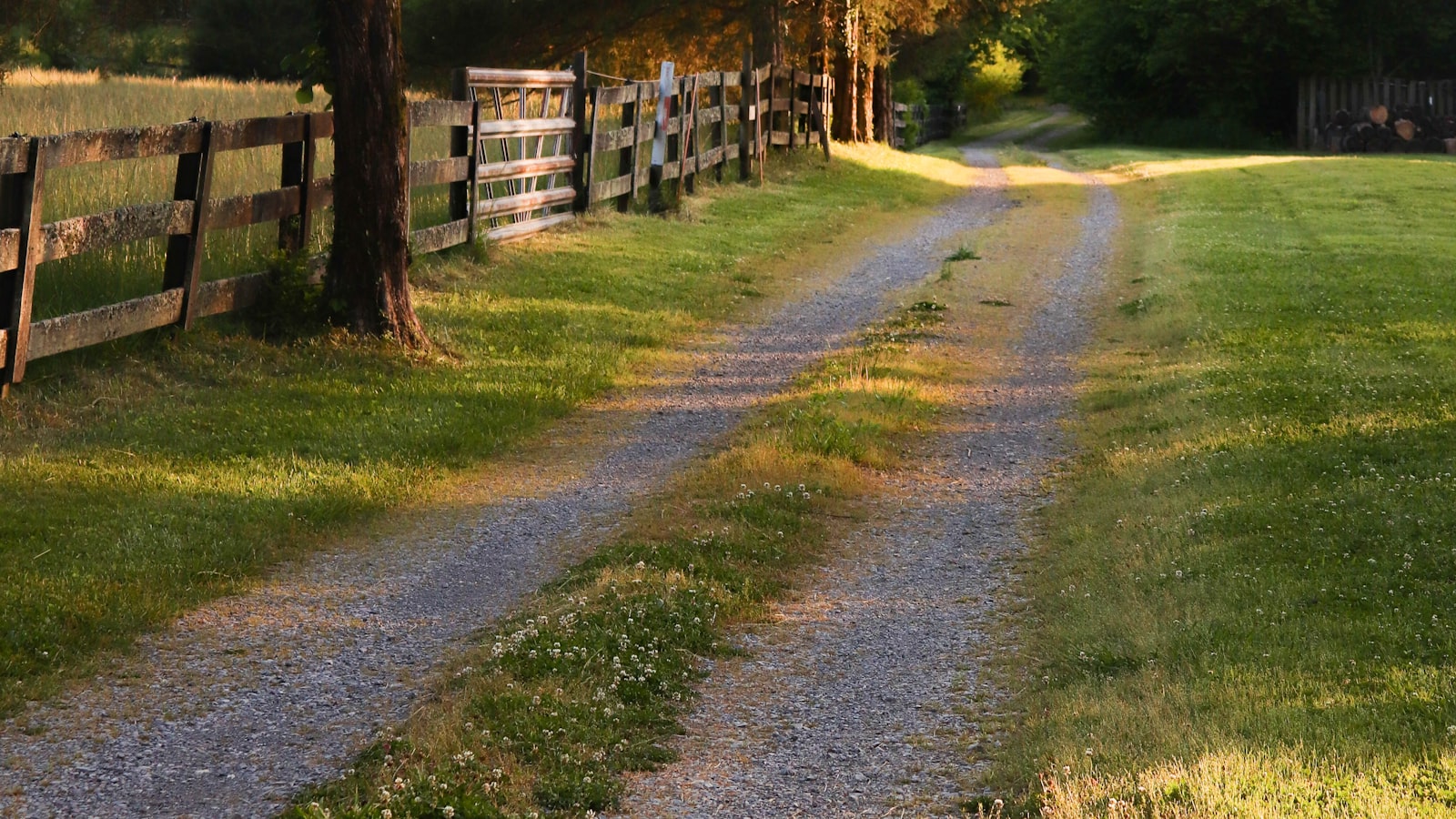
Why Your Gravel Driveway Washes Out Every Spring — and the Base, Crown, and Culvert Fixes That Stop It
Every spring it's the same call. Rain sits over Maury and Williamson County for three days straight, and when it finally clears there are ruts down the middle of the driveway deep enough to catch a bumper. The gravel that was there in the fall is now in the ditch, in the yard, or halfway out to the road.
Most people fix that by ordering another load of gravel. Then they do it again the next spring, and the one after that. Nothing changes, because the gravel was never the problem.
Your Driveway Isn't Losing Gravel. It's Losing a Fight With Water.
A gravel drive fails when water runs down it instead of off it. Once water picks a line and starts moving, it carries the small material first — the fines and dust that lock the stone together. What's left behind is loose rock with nothing binding it. That's where washboard, ruts, and potholes come from.
Tennessee clay makes it worse. Clay doesn't drain. Water that soaks through a thin layer of gravel hits that clay, sits there, and turns the base soft. Run a loaded truck across it and the rock disappears into the mud. It didn't wash away — it got pumped down into the subgrade, which is why the drive can look starved for gravel even when nothing left the property.
So the fix is never just more stone on top. It's three things working together: a base that carries the load, a crown that sheds water off the surface, and a culvert and ditch system that takes that water somewhere.
Fix One: Build a Base That Actually Carries the Load
A driveway is a structure. It needs a bottom layer built to spread weight, not a scattering of good-looking rock sitting on dirt.
That starts with stripping the topsoil and organic material off the driving surface. Topsoil holds water and never compacts. Leave it under a drive and you've guaranteed yourself a soft spot. Once we're down to firm subgrade, the base course goes in — larger angular crushed stone, placed in lifts and compacted, not dumped and spread.
Angular matters. Crushed stone has sharp faces that key into each other and lock up under compaction. Rounded river gravel rolls. If your drive feels like driving on marbles, that's usually why.
How deep the base needs to be depends on what the drive has to carry and what the soil under it is doing. A drive that only sees pickups and passenger cars is a different build than one taking a concrete truck to a barn pad or delivery trucks to a shop. Soft clay often needs geotextile fabric between the subgrade and the base to keep the two from mixing. That fabric is cheap compared to building the same driveway twice.
Fix Two: Crown It, So the Water Leaves
The crown is the slight ridge running down the center of the drive. It's the most overlooked part of a gravel driveway and usually the cheapest thing to get right.
A properly crowned drive sits higher in the middle than at the edges, so rain runs sideways off the surface within a few feet instead of collecting and running the length of the driveway. Flat drives puddle. Dished drives — high on both edges, low down the center, which is what most drives turn into after a few years of traffic — become a creek every time it rains hard.
Crown gets lost over time. Tires push material toward the edges, ruts deepen, and the drive slowly inverts itself. Regrading to re-establish the crown and then recompacting is routine maintenance, and on a lot of properties it is the entire fix. If your driveway still has good rock but bad shape, you may not need material at all. You need what's already there put back where it belongs.
Long drives on a grade need more than crown. Water running downhill for a few hundred feet picks up enough speed to cut regardless of surface shape. Those drives need the water turned off the surface at intervals — broad shallow diversions across the drive, or ditching alongside it that catches the flow and carries it away before it can build.
Fix Three: Size the Culvert for the Water You Actually Get
Where a drive crosses a ditch, a swale, or a low spot, a culvert carries that water under the driveway instead of across it. Get the culvert wrong and everything upstream backs up while everything downstream scours out.
The failures are usually simple. The pipe is too small for the ground draining into it, so it overtops in a hard rain and the water goes over your driveway. Or the pipe is set too high or at the wrong slope, so it silts in and quits flowing. Or it's clean and correctly sized, but the inlet and outlet were never armored with rock, so the ends erode until the pipe undermines and settles.
Sizing is a field call, not a number out of a catalog. It depends on how much land drains to that point, how steep it is, and what the ditch looks like coming in. The ditches matter as much as the pipe — a culvert can only move what the ditch delivers to it, and a ditch full of brush and silt delivers water over the top of your drive instead.
Which One Does Your Driveway Need?
Some drives need a full rebuild from the subgrade up. Plenty of others just need to be regraded, crowned, and compacted, with one bad culvert cleaned out or replaced. The only way to know which one you're looking at is to walk it — ideally right after a hard rain, when the water shows you exactly where it wants to go.
We build new gravel driveways, install culvert pipe, and repair and regrade washed-out drives across Maury, Williamson, and Marshall counties — Columbia, Spring Hill, Mount Pleasant, Franklin, Thompson's Station, Nolensville, Arrington, Lewisburg, and Chapel Hill. Built right and built to drain.
Request a free on-site quote and we'll come look at the driveway. Most quotes go out within 24–48 hours, and most projects are scheduled within 2–4 weeks of a signed quote. If it's easier to talk it through, call or text (615) 669-1442 — you'll talk to the person running the job, not a call center.