
Forestry Mulching vs. Cut-and-Haul Clearing: Which One Your Maury County Acreage Actually Needs
You bought the acreage. Maybe it's twelve acres off a gravel lane outside Columbia, maybe it's a five-acre tract in Mount Pleasant that's been sitting in cedar and honeysuckle since the last owner stopped bush-hogging it. Either way, you can't walk it, you can't see the property pins, and you can't do anything with it until it's cleared.
So you start calling around and you get two very different answers. One outfit says forestry mulching. The next says cut it, pile it, and haul it off. The prices aren't close, and neither is the finished product.
Here's the honest version. Neither method is better. They do different jobs. Picking the wrong one is how people spend real money and still end up with land they can't build on.
What forestry mulching actually does to your land
A mulcher is a drum with carbide teeth on the front of a track machine. It grinds standing brush, saplings, briars, and small trees into chips and lays them right back down on the ground. Nothing leaves the property. There's no burn pile, no dump truck, no debris to deal with.
When it's done you've got open, walkable ground under a mat of wood chips a few inches deep. That mat is doing work for you — it holds the soil through a Middle Tennessee spring, keeps the topsoil from washing into the creek, and breaks down over a couple of seasons.
What mulching does not do is get the roots out. The stumps and root balls stay in the dirt. Depending on the machine and the job, stumps come off at or near grade, but the root system is still down there. Two things follow from that. First, anything that resprouts from a live root — privet, honeysuckle, sweetgum, hackberry — will come back if you don't stay on it. Second, that ground is not ready for a foundation, a pad, or a pond.
Mulchers also have a diameter limit. Brush, briars, cedar, and saplings up to roughly eight to ten inches are what they eat well. Mature hardwoods aren't a mulching job.
What cut-and-haul clearing actually does
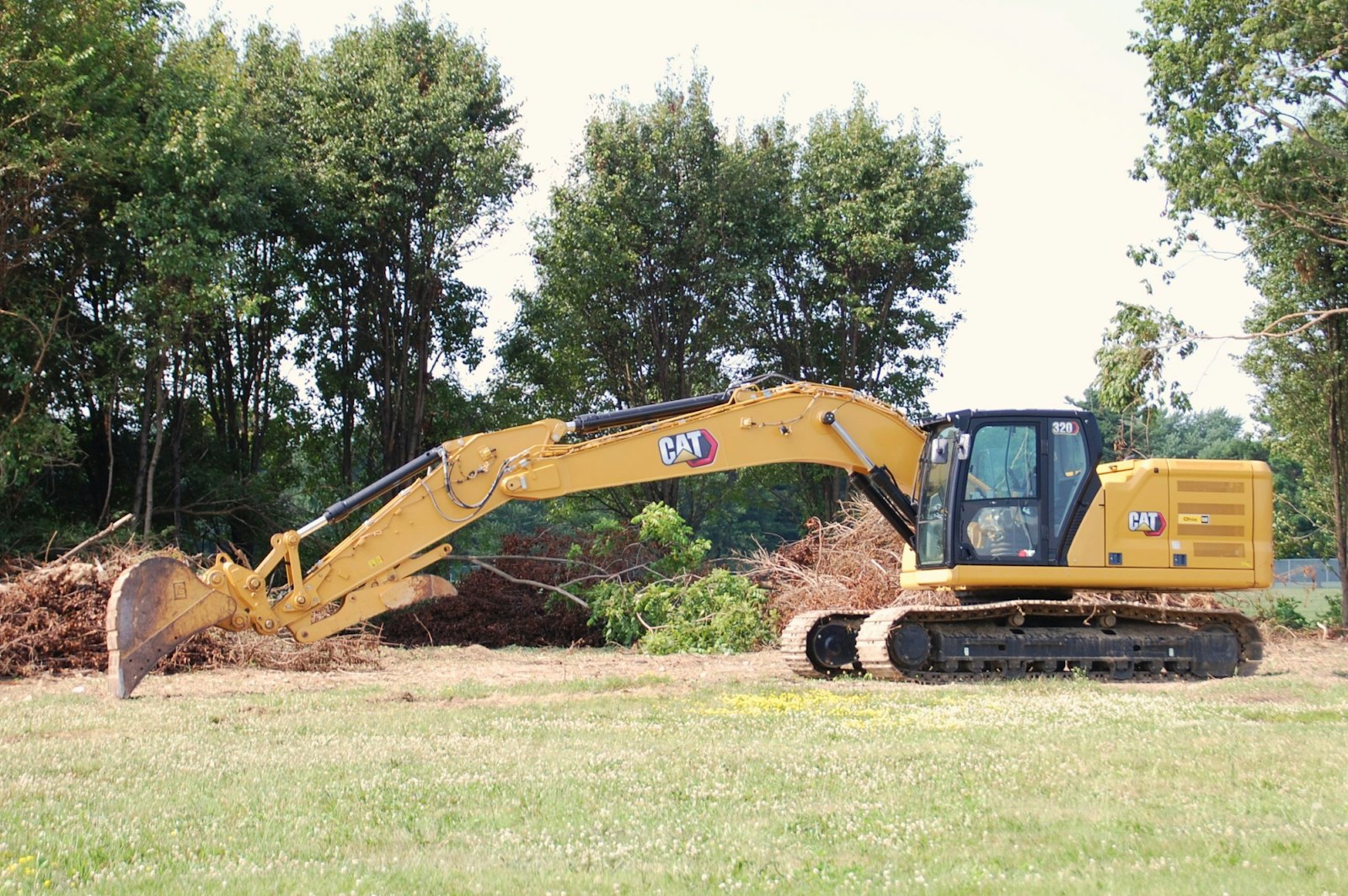
Cut-and-haul is the full removal. Trees come down, stumps get ground or pulled, root balls come out, and the material leaves — hauled off, piled, or burned where the county allows it. What you're left with is dirt.
That's the point. If somebody has to dig in it, pour on it, or drive a loaded truck across it, you need the roots gone. A house pad with a rotting root ball under one corner is a settling problem you'll be looking at for twenty years. A pond dug through old stump holes is a seep waiting to happen.
It's the slower method and it's the more expensive one, because you're paying for the removal and then for whatever you do with the debris. But it's the only one that produces buildable ground.
One thing to plan for on Tennessee clay: cut-and-haul leaves bare dirt. Bare dirt on a slope in April is going to move. Grading and seeding should be part of the conversation before the machines pull out, not a month later after the first hard rain has cut a channel through your driveway.
Five questions that decide it
1. What's going on this ground? Building a house, a barn, a shop, or a pond means cut-and-haul. Opening up pasture, cleaning a fence line, restoring a view, cutting trails, or making the back forty walkable again means mulching.
2. How big is the wood? Brush, cedar thickets, and saplings mulch fast. Mature oak and hickory don't. Walk the tract and look at trunk diameter — that single fact rules out one of the two methods on most jobs.
3. How thick is it, really? Overgrown pasture that's been idle five years mulches quickly. Thirty years of woody growth is a different machine-hour number, and mulching stops being the cheap option somewhere in there.
4. What are you doing with the debris? With mulching, that question doesn't exist. With cut-and-haul it's a real line on the quote — mulched in place, burned where it's permitted, piled on site, or trucked off. Burning gets complicated fast inside city limits in Columbia, Spring Hill, Franklin, or Nolensville, so check your address before you plan around it.
5. Can equipment get in? A steep, wet, or gated tract with soft ground changes the machine we bring and the days it takes. Access drives cost more than most people expect on both methods.
What each one does to your bill
We won't quote you a per-acre number on a web page, and you should be careful with anyone who will. Price on a clearing job moves with acreage, terrain, how thick and how big the growth is, how the machines get in, and what happens to the debris. Two ten-acre tracts a mile apart in Thompson's Station can quote very differently.
What we can tell you is the shape of it. Mulching is usually the lower number on light-to-moderate brush, because it's one machine, one pass, and no haul-off. Cut-and-haul carries the removal and the disposal, so it runs higher on the same acre — and it's worth it when you need dirt you can build on.
The expensive mistake isn't picking the pricier method. It's mulching ground that was always going to need a pad, then paying a second crew to come back and pull the stumps you already paid to grind.
Most Maury County jobs end up using both
That's the part nobody tells you. On a real tract, you rarely need one method across the whole property.
Say you've got fifteen acres outside Columbia and you're putting a house and a shop on the front three. Those three acres get cut-and-haul — trees out, stumps out, roots out, graded and ready for the builder. The back twelve get mulched: open, walkable, no burn pile, and you can see your own property line for the first time.
Same story on a Chapel Hill homestead adding a barn, or a Lewisburg tract where the front needs a real gravel drive and a culvert and the back just needs to stop being a thicket. You clear each part of the property for what that part is actually going to do.
That's the conversation we'd rather have standing on your land than over the phone. Once we've walked it, we can tell you which acres need which method and why — and you'll have a number instead of a guess.
Get a straight answer on your acreage
Aurora Excavators is a licensed Tennessee General Contractor, fully insured, ten-plus years working Maury, Williamson, and Marshall County ground. We run the mulchers, the dozers, and the excavators, so we're not steering you toward the method we happen to own.
Request a free on-site quote at auroraexcavators.com/quote and we'll walk the property with you. Most quotes go out within 24 to 48 hours, and most projects get scheduled within two to four weeks of a signed quote. If you'd rather just talk it through, call or text (615) 669-1442.
Boots on the ground. Equipment in the dirt. Cleared, graded, and ready to build.